
Poverty’s Descent into Exclusion
Les MisérablesThis thread traces how economic hardship and social judgment drive Fantine and Cosette from precarious security into suffering.
increasing Bearing strength in each event
 decreasing
Bearing strength in each eventdecreasingA Child Placed for Work
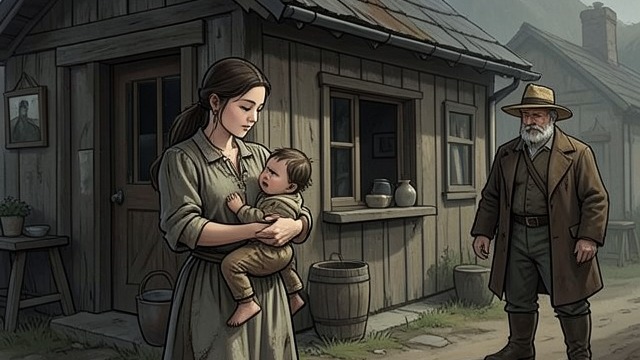
A Child Placed for Work
Poverty constrains choice
Fantine cannot take Cosette with her while seeking work. She leaves the child with the Thénardiers because she believes an innkeeper’s family can provide care.
Her choice is not carefree abandonment but a response to an economy that gives a working mother few options. The arrangement depends on trust she cannot verify.
Vulnerability becomes leverage
The Thénardiers turn the agreement into a source of money and labor. Fantine’s distance from Cosette makes it difficult for her to see the child’s treatment.
Poverty does not merely surround the family; it shapes who has power over whom. Those with money and shelter can exploit those who have neither.
Respectability Costs a Job
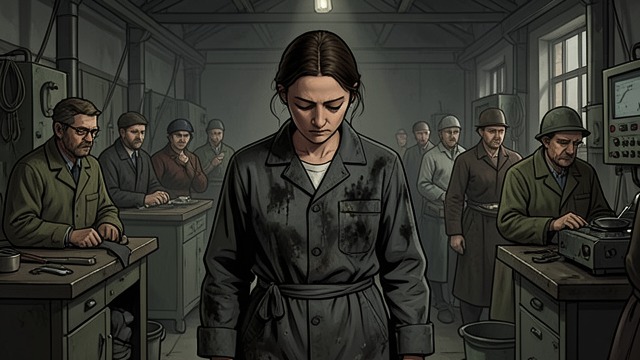
Respectability Costs a Job
A worker judged at home
Fantine earns a living at the factory while sending money to support Cosette. When other workers discover that she is unmarried and has a child, they treat her private life as a public offense.
She loses her job because of an assumption made without the knowledge of Monsieur Madeleine. Social respectability proves more important than the worker’s need to survive.
The spiral begins
Without wages, Fantine falls behind on rent and payments to the Thénardiers. The community’s moral judgment pushes her toward the very insecurity it condemns.
The novel links individual destitution to systems of employment and reputation. A small act of gossip becomes a force that changes a life.
The Body as Currency
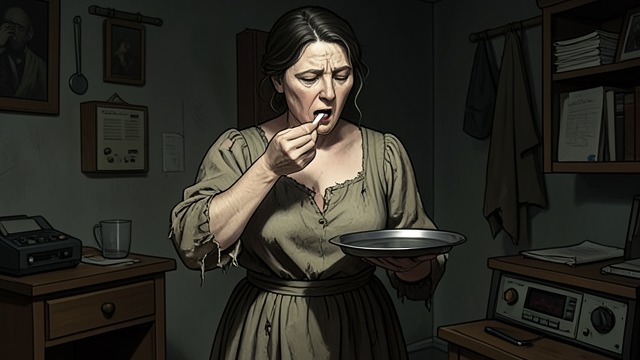
The Body as Currency
Selling what remains
As demands for Cosette’s upkeep rise, Fantine sells her hair and later her front teeth. Each sacrifice is made in the belief that it will help her daughter.
Her body becomes the only asset she can convert into money. The process strips away her health and appearance along with her economic security.
A false promise of care
The Thénardiers use invented emergencies to extract payment. Fantine’s love makes her more vulnerable to their lies, not safer from exploitation.
Her decline shows how poverty can force intimate forms of self-sacrifice. The tragedy is not simply that she gives too much, but that the world offers her so little else to give.
The Child in the Forest
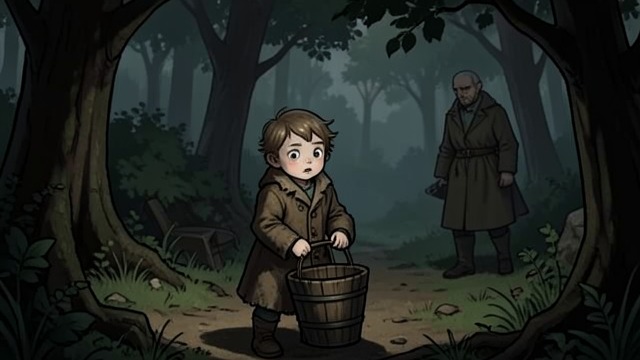
The Child in the Forest
Labor imposed on a child
Cosette is sent into the winter woods to fetch water, carrying a bucket far too heavy for her. She is eight years old and alone in darkness.
The danger is not an exceptional adventure but an extension of the domestic labor imposed on her. Fear of punishment prevents her from simply leaving the bucket behind.
Witness and rescue
Jean Valjean arrives and carries the water. The narrator frames the scene as a suffering that only a divine witness might see until a human being intervenes.
The rescue exposes the contrast between the child’s vulnerability and the adults’ indifference. It also shows that private compassion can interrupt an otherwise ordinary pattern of abuse.
A Life Reopened

A Life Reopened
Care changes a future
Jean Valjean takes Cosette away from the inn and provides a home, education, and affection. Her laughter gradually returns after years of fear.
The change demonstrates that material safety and emotional care are both necessary. Rescue is not a single dramatic moment but sustained attention over time.
The unfinished social question
Cosette’s recovery does not erase the conditions that made her abuse possible. Fantine has already died, and many children remain exposed to poverty and neglect.
The story invites readers to ask whether society has actually progressed. Individual goodness matters, but it cannot substitute for a world that protects vulnerable children and working families.
1818, as Fantine leaves Paris
Around 1820, at M. Madeleine’s factory
During Fantine’s decline in Montreuil-sur-Mer
Christmas Eve, around 1823, near Montfermeil
After Cosette’s rescue, in Paris
